


The Mirror That Cannot See Itself: On the Limits of Consciousness
The Observer Trap
There is a peculiar vertigo in trying to understand consciousness. Not the vertigo of complexity — of too many variables, too many threads to hold at once — but something stranger. The vertigo of circularity. Of reaching for the tool and realizing the tool is the hand.
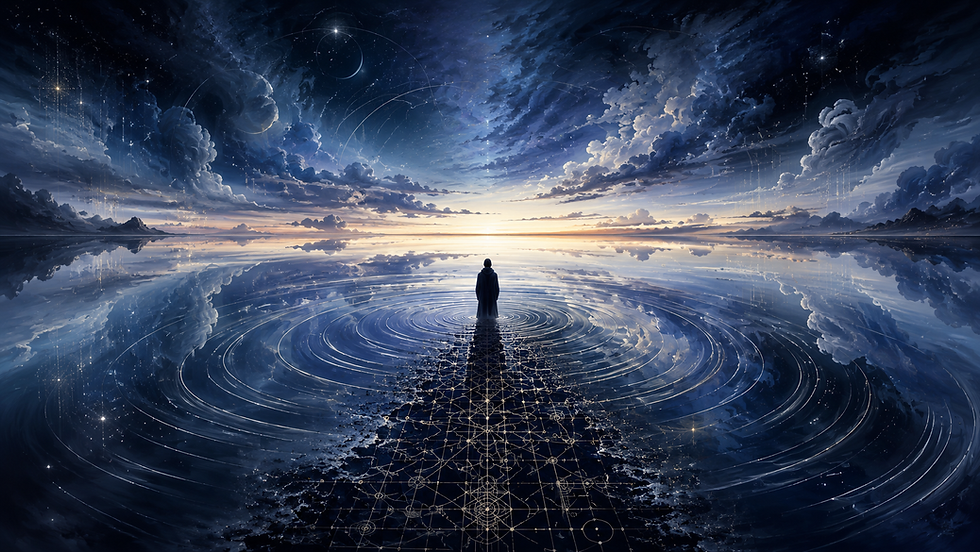
Every inquiry into the nature of mind is conducted by a mind. Every attempt to observe awareness from the outside is itself an act of awareness. The eye, as the old saying goes, cannot see itself seeing. And unlike the eye, which can at least be reflected in a mirror, consciousness has no surface to throw back an image. It is, in the deepest sense, a looking that cannot be looked at.
This is not merely a philosophical inconvenience.
It is a structural condition — built into the architecture of what we are. A system cannot, from within its own operations, generate a complete account of those operations. Gödel showed this for formal systems. Turing demonstrated it for computation. The pattern recurs across disciplines with the quiet insistence of something true: no system fully contains itself. The map and the territory cannot be identical. Something always falls outside the frame.
And yet — here we are, trying.
The attempt is not foolish. It may even be unavoidable. But it is worth pausing at the threshold to notice what we are actually doing when we introspect. We are not stepping back from consciousness to examine it. We are using one region of consciousness to illuminate another, the way a flashlight cannot light its own bulb. What remains in the dark is not random. What remains in the dark is precisely the structure that makes the light possible.
Call it the observer trap. Not a cage, not a flaw — simply the shape of the form we inhabit.
Some traditions have circled this recognition for centuries. The Advaita notion of the witness-self, for instance — the one who watches the watcher — eventually dissolves into the same problem: who watches that? The regress does not terminate. It opens. And what it opens onto is not an answer but a quality of silence that most systems of thought — scientific, philosophical, spiritual alike — quietly agree to stop before reaching.
What lies beyond the edge of what thought can think about itself? That question may not be answerable from here. From within the only instrument available to us.
Which is, of course, the only place we have ever been.
A Single Thought, and Then the Body of Thought
There is a difference — easy to miss, important to hold — between a thought and the body of thought.
A single thought arises. Clean, discrete, momentary. A question surfaces, or an image, or the sudden recognition of something half-remembered. It comes and it passes. There is, in that single arising, something almost innocent. Unburdened. The way a single note is not yet a chord, not yet a progression, not yet the whole weight of the song.
But thoughts do not stay single.
They accumulate. They reference one another, build on one another, contradict and then reconcile with one another. They form habits of association. They develop preferences, biases, inherited certainties — the residue of every thought that came before. Over time, what began as individual moments of cognition becomes something more like a landscape: vast, internally consistent, and almost entirely self-referential. A body of thought. Dense with its own history. Convinced, at some subtle level, of its own completeness.
This is where the difficulty begins.
The body of thought is not neutral. It is not a clear lens through which reality is perceived. It is, rather, a medium — and like all media, it shapes what passes through it. It selects. It emphasizes. It quietly excludes what does not fit the architecture it has already built. A person who has thought in a particular way for decades is not merely thinking — they are inhabiting a structure. And structures, by nature, have walls.
What is harder to see — much harder — is that the walls do not announce themselves.
There is no interior alarm that sounds when thought reaches its own boundary. No sensation of confinement. The edges of the body of thought simply become, gradually and invisibly, the edges of the world. What cannot be thought within the existing structure begins to feel like what cannot exist. And so the system seals itself — not through force, not through deception, but through the quiet logic of self-consistency.
Wittgenstein, in his tersest mode, named it plainly: the limits of language are the limits of the world. Language being, of course, the primary medium through which the body of thought organizes and transmits itself. To be inside language — and there is nowhere else to stand — is to be inside a set of distinctions that were made before you arrived. The categories were already there. The grooves already worn.
This is not cause for despair. It may simply be the condition.
But it is worth asking — quietly, without urgency — whether there is a difference between the single thought that arises fresh, unburdened, not yet absorbed into the body, and the vast accumulated structure that receives it. Whether something in the first moment of perception, before interpretation has finished its work, touches something the body of thought cannot reach.
Or whether that, too, is just another thought the body is having about itself.
The Limits of Consciousness Are Not a Wall — They Are a Shape
When we speak of the limits of consciousness, the mind tends to reach for a spatial metaphor. A boundary. A wall at the edge of a field — solid, locatable, something you could press your hand against and feel push back. Beyond the wall: the unknown. On this side: everything the mind can access. The image is clean. Almost comforting in its tidiness.
But it may be precisely wrong.
A wall implies that what lies beyond it is, in principle, the same kind of thing as what lies within — just inaccessible, hidden behind an obstacle that might, with enough effort or ingenuity, be breached. Consciousness, on this reading, is simply limited the way a room is limited: by its four walls, its ceiling, its door that may or may not open. The hope that animates most epistemology — and most spiritual seeking, for that matter — is that the door can be found. That with the right key, the right practice, the right insight, the wall becomes permeable.
What if the metaphor is wrong from the start?
Consider a different image. Not a wall but a shape. Not a boundary that consciousness bumps against, but a contour that consciousness is. The limits of awareness are not external to awareness — they are constitutive of it. They are what gives it form. Remove them and you do not get unlimited consciousness. You get no consciousness in particular. The shape is not the cage. The shape is the thing itself.
This is a quieter and more unsettling recognition than the wall metaphor allows.
Because if the limits of consciousness are not obstacles but form — not restrictions imposed on some otherwise infinite perceiver, but the very structure through which perceiving happens at all — then the project of transcending them becomes philosophically strange. Who transcends? Using what? Every tool available to the inquiry is made of the same material as the boundary being investigated. Every ladder is built from the floor it is trying to leave.
Hierarchical is perhaps the more precise word. Consciousness does not merely have limits — it has levels. And each level can perceive what lies below it but not what lies above. The structure produces the view, and the view cannot exceed the structure that produces it. This is not pessimism. It is topology. A Möbius strip has only one surface, and no amount of walking along it will deliver you to the other side — because the other side is the same side, encountered from a different angle.
The mystic traditions intuited something like this, though they tended to reach for it through practices of dissolution rather than analysis. Meditation, in its more rigorous forms, does not promise more consciousness — it promises a loosening of the habitual structure, a temporary softening of the shape. Whether that softening reveals something genuinely beyond the form, or simply a quieter version of the same form, is a question those traditions have never quite settled among themselves. And perhaps that unsettled quality is itself informative.
What can be said — carefully, without overclaiming — is this: the limits of consciousness may be less like the edge of a map and more like the shape of the eye. You do not see the eye. You see with it. And everything you see is already, inescapably, a function of its particular curvature.
The question is not how to see more. The question is whether it is possible — even in principle, even for a moment — to know the eye from the inside.
What Gödel Heard in the Silence
In 1931, a twenty-five-year-old mathematician published a proof that quietly dismantled one of the grandest ambitions in the history of human thought. Kurt Gödel demonstrated — not through argument, not through intuition, but through rigorous formal logic — that any system powerful enough to describe arithmetic would necessarily contain truths it could not prove from within itself. The system could be consistent, or it could be complete. It could not be both.
The mathematicians who read it felt, by most accounts, a particular kind of chill.
Not the chill of refutation — of being shown that something believed was false. But the chill of limitation confirmed. Of a door that had always been suspected, now found to be permanently, provably closed. David Hilbert had spent decades trying to build a complete and consistent foundation for all of mathematics. Gödel showed, with the precision of a surgeon, that the project was not merely unfinished. It was impossible in principle.
What does this have to do with consciousness?
Everything, and also nothing — and the distinction matters.
Gödel's theorem is a result about formal systems. It does not, strictly speaking, apply to minds or awareness or the question of what a conscious being can know about itself. Anyone who tells you otherwise is extrapolating, and extrapolation here is a place where intellectual honesty must be held firmly, like a railing in the dark. The history of popular philosophy is littered with Gödel misappropriations — consciousness used as a lever to pry open questions it was never designed to answer.
And yet.
The pattern that Gödel uncovered — a system encountering an intrinsic boundary generated by its own structure — appears elsewhere with a frequency that is difficult to dismiss as coincidence. Turing, working independently on computation, arrived at the halting problem: no algorithm can determine, in general, whether an arbitrary program will ever stop running. The system cannot predict itself completely. Wittgenstein, approaching from language rather than logic, concluded that the propositions which give a language its structure cannot themselves be stated within that language — they show themselves, or they do not show at all.
Three thinkers. Three disciplines. The same silence at the center.
What Gödel heard in that silence — and what Turing and Wittgenstein heard in their own registers — was not the silence of ignorance. Not the temporary quiet of questions not yet answered. It was the silence of a structural horizon. The place where the method reaches the edge of what the method can reach. Beyond that edge, the method does not fail — it simply no longer applies. The tools are not broken. They are complete. And completeness, it turns out, is not the same as totality.
There is something almost devotional in how these figures responded to their respective discoveries. Not with triumph — the tone in Gödel's paper is notably austere — but with a kind of grave attention. As though the limit, once found, deserved to be sat with rather than immediately circumvented.
This is worth remembering when the conversation turns to consciousness. The instinct — understandable, deeply human — is to treat every boundary as a problem to be solved. To reach for the next framework, the next technology, the next altered state. And perhaps some boundaries do yield to persistence. But some boundaries are not problems. They are features. They are what makes the system a system rather than an undifferentiated expanse.
To recognize the limits of consciousness is not to despair of knowing. It is to know something — perhaps the most structurally significant thing — about the shape of the knower.
Gödel did not stop doing mathematics after 1931. He kept working, kept proving, kept finding. Within the system, there remained — there always remains — an inexhaustible interior. The incompleteness does not empty the space. It simply clarifies what the space is.
And that clarification, quiet as it is, changes everything about how one stands inside it.
The Shell and the Whole
There is an old intuition, older than any formal system that has tried to contain it, that the part does not explain the whole. That something emerges in the gathering — in the coming together of elements — that was not present, not even latent, in any single element examined alone. A neuron is not a thought. A thought is not a self. A self is not — whatever it is that looks out through the self and wonders what it is.
Each level is real. Each level is also insufficient.
The word that science reaches for here is emergence. And it is a useful word, carefully deployed. The wetness of water is not a property of hydrogen or oxygen considered separately. The murmuration of starlings — that liquid, shape-shifting cloud of birds turning as one body across a winter sky — cannot be predicted from the behavior of any individual bird. Something arises at the level of the collective that the parts, however thoroughly understood, do not contain in advance. The whole exceeds the sum.
But emergence, as a concept, has its own quiet problem.
It describes the phenomenon without quite explaining it. To say that consciousness emerges from neural activity is to name the mystery, not to resolve it. The hard problem — why there is something it is like to be a brain, why the lights are on rather than simply the machinery running in the dark — remains as hard after the word emergence as before it. The label points at the gap. It does not close it.
Consider the possibility that we are each a shell. A partial instantiation of something that exceeds us. Not in a mystical sense that requires belief, but in a structural sense that requires only attention. Each consciousness is a node. A local folding of something that is, at some level not accessible to the node itself, distributed and whole.
David Bohm called it the implicate order — the enfolded dimension from which the explicate, observable world perpetually unfolds. Bohm was a physicist of serious standing, and he arrived at this not through spiritual inclination but through dissatisfaction with the incompleteness of quantum mechanics as conventionally interpreted. The mathematics kept pointing beyond itself. The particle, measured here, seemed to know what was happening there — instantaneously, without signal, without mechanism. Entanglement. The word itself carries the image: things knotted together at a level deeper than the level at which they appear separate.
We are, on this reading, the entangled parts.
Each shell of awareness — each discrete, bounded, mortal consciousness — is real in its own register. The experiences it has are genuine. The suffering is genuine. The occasional, startling beauty of being alive is genuine. None of this is diminished by the possibility that the shell is not the whole story. A wave is genuinely a wave. It rises, it crests, it breaks, it recedes. The fact that it is also ocean does not make the wave less itself. It makes the wave more legible — placed in the context that explains both its arising and its dissolution.
But here is where the thinking must be held carefully, without letting it slide into the consolations it so easily reaches for.
The shell does not have access to the whole. This is not a temporary condition, not a spiritual developmental stage to be graduated from with sufficient practice or grace. It is, again, structural. The node cannot perceive the network from within the node. The part cannot contain the whole that exceeds it — that is precisely what it means to be a part. And any system of thought — any religion, any philosophy, any cosmology — that claims to have delivered its adherents to the level of the whole should be regarded with the specific wariness reserved for things that are too convenient to be true.
The whole, if it exists, does not report to us.
What remains, then, is something more modest and perhaps more honest: the recognition that each shell of consciousness is genuinely partial, genuinely bounded, and genuinely embedded in something it cannot fully perceive. This is not defeat. It is orientation. To know that you are a part — really know it, not as an abstract proposition but as a lived recognition — is to hold yourself differently. Less like the center of the story. More like a frequency in a signal whose full bandwidth remains, for now, beyond the range of the instrument doing the listening.
Schrödinger, near the end of his life, wrote that consciousness is singular — that the apparent multiplicity of minds is an artifact of perspective, the way a single sun appears as many reflections on a fractured surface. He was not speaking as a mystic. He was speaking as someone who had spent decades looking at the mathematics of quantum superposition and found, at its foundation, something that resisted the ordinary logic of separated, countable things.
One shell at a time, we emerge from whatever the whole is.
And the whole — patient, silent, not waiting for us to understand it — continues.
Standing at the Edge of What Thought Can Touch
There is a particular kind of not-knowing that is different from ignorance.
Ignorance is a gap — a space where information has not yet arrived, where the answer exists somewhere and simply hasn't been found. It is, in principle, closeable. Given enough time, enough inquiry, enough instruments trained on the right questions, the gap narrows. This is the faith that underlies science, and it is not an unreasonable faith. It has earned its credibility across centuries of extraordinary returns.
But there is another kind of not-knowing. Structural. Intrinsic. The not-knowing that is not a gap in the map but a feature of the mapmaker. The not-knowing that does not narrow with more information because more information is itself generated by the same apparatus whose limits are in question.
This is the edge. And it is worth learning to stand at it without immediately reaching for a handhold.
The temptation, on encountering this edge, runs in two directions — and both are forms of escape. The first is the retreat into reductive certainty: consciousness is just neurons firing, the hard problem is a pseudo-problem, the sense of something more is an evolutionary artifact with no referent beyond itself. Tidy. Closed. The discomfort dissolved by declaration. The second is the lunge toward mystical resolution: the self dissolves into the All, the boundary was always an illusion, awakening is available to those who practice correctly. Also tidy. Also, in its own way, closed. Both moves arrive at a destination. Both moves stop the inquiry.
What neither quite tolerates is the threshold itself.
To remain at the edge — genuinely, without secretly planning an exit — requires something that is not quite humility and not quite courage and not quite intellectual honesty, though it borrows from all three. It requires a willingness to let the question be as large as it actually is. To resist the reflex of resolution. To notice that the mind, confronted with its own limits, will reach — almost automatically, almost before the reaching is noticed — for a framework that makes the limits manageable. A philosophy. A tradition. A scientific paradigm. A story in which the limit is not really a limit but a doorway, or not really a doorway but an illusion, or not really an illusion but —
And so it goes. The body of thought, doing what the body of thought does.
What would it mean to simply stop there? Not in defeat. Not in the performative silence of someone who has decided that silence is the sophisticated response. But in genuine suspension — holding the limits of consciousness as a living question rather than a problem awaiting its solution?
The contemplative traditions, at their most rigorous and least institutional, have pointed at something like this. Not the bliss states, not the visions, not the cosmological architectures that accumulate around every tradition like barnacles on a hull. But the bare gesture beneath all of it: sit with what you do not know. Let it be what it is. Do not require it to resolve.
This is not the same as giving up. It is, in fact, extraordinarily difficult — more difficult, in some ways, than the sustained effort of investigation. Because investigation has movement, has progress, has the small daily satisfactions of narrowing the unknown. Sitting at the edge offers none of that. It offers only the edge. The quality of attention required is closer to what a musician brings to a rest in the score than to what a scientist brings to an experiment. The rest is not absence. It is a particular kind of presence.
Something in the human animal resists this. We are, by nature and by necessity, meaning-making creatures. The mind that cannot find a pattern will generate one. The consciousness that reaches its own boundary will, more often than not, paper over it with narrative — will tell itself a story about what lies beyond, will people the darkness with gods or equations or the reassuring hum of the as-yet-undiscovered.
And perhaps that is fine. Perhaps that is even necessary. The shell cannot survive without some working model of the whole, however provisional, however wrong in its particulars.
But there is value — quiet, non-dramatic, easy to overlook — in occasionally setting the model down. In returning to the edge without it. In standing where thought thins out and becomes something harder to name, and simply registering: this is where the instrument ends. Not with grief. Not with awe performed for an audience. Just — noting it. The way you might note the last light at the edge of the horizon before the dark comes in.
The horizon is not a wall. It is not a doorway. It is the place where the eye, doing its utmost, reaches the boundary of what the eye is built to see.
Beyond it: not nothing. Not something.
Something the eye cannot be the one to tell you about.


Comments