


The River With No Banks: Reflections on the Flow of Time

The Most Certain Thing
Notice it now, before the thought finishes forming: something is already slipping past.
The light has moved a finger's width across the floor since you sat down. A sound has begun and ended. The breath you were taking is gone, replaced by the next. None of this requires belief. It arrives without being asked — the most ordinary fact of being awake, that we are not standing still in our lives but moving through them, carried, as if downstream.
We speak of it without thinking. Time flies. Time drags. We are running out of it, killing it, making up for the amounts we lost. Every metaphor reaches for motion, and most of them reach for water — a river, a current, a tide that carries everything eventually out to sea. The image feels less like a figure of speech than a report. There is a flow, and we are in it.
Of all the things a person can doubt, this seems the last to go. You might question whether the table in front of you is really solid, whether color exists outside the eye, whether the self is one thing or a committee. But the sheer passing of moments — the relentless conversion of not-yet into now into no-longer — feels like bedrock. It is the water the rest of experience swims in.
And yet.
Press on it even slightly and the certainty thins. What, exactly, is moving? Not me; I am here, the same here I was a moment ago. Not the clock, which only turns, and turning is not the same as flowing. Ask where the present is and you cannot hold it — by the time the question lands, the now you meant is already behind you. We are sure that time passes, yet we cannot point to the thing that passes, or say where it goes, or how fast. Fast compared to what other time?
This is the seam worth sitting in. The flow of time is at once the most obvious feature of being alive and the one that comes apart most readily in the hand. We feel it the way we feel weight or warmth — immediately, without argument. But unlike weight, which physics hands back to us measured and explained, this feeling seems to point at something the deepest descriptions of the world quietly fail to contain.
Maybe the feeling is a faithful report of how things are.
Or maybe it is the most convincing thing the mind has ever made.
What Physics Forgets to Mention
Take the question to the people whose work is to describe the world as precisely as possible, and something disorienting happens. They hand back equations of extraordinary reach and accuracy — and nowhere in them is the river.
Start with the present moment, the now that feels like the leading edge of everything. Relativity quietly removes it. Once Einstein showed that two events judged simultaneous by one observer can fall out of step for another moving differently, the idea of a single cosmic instant — one shared now advancing through the universe for everyone at once — loses its footing. Whose now would it be? There is no privileged answer. The present stops being a moving frontier and starts to look more like the word here: true wherever you happen to be standing, but not a place the universe itself singles out.
From there the picture widens into something stranger and stranger to live with. In the view many physicists settle into — the so-called block universe — past, present, and future are equally real, laid out together as a single four-dimensional whole. You are not a point being swept downstream. You are a long shape extended through that block, present at every moment you ever occupy, the way a road is present along its whole length rather than at the spot where you happen to be driving. Nothing flows. Nothing becomes. The landscape simply is, and the sense of travelling through it is supplied by the traveller, not the terrain.
Even the one asymmetry that seems unshakeable — that the past is fixed and the future open — turns out to live somewhere unexpected. The fundamental laws barely distinguish forward from backward; run most of them in reverse and they remain perfectly lawful. The arrow we feel so vividly comes instead from entropy, the overwhelming statistical tendency of things to spread out and disorder, traced back to a universe that began in an extraordinarily ordered state. That gives us a direction, a downhill. But a direction is not a current. The hill does not flow. We do.
Einstein himself, writing to console the family of a friend who had died, reached for almost this exact thought — that the division of time into past, present, and future is a kind of illusion, however stubbornly it persists. Coming from him it can sound like cold comfort. It can also sound like the most radical thing a grieving person has ever been offered.
None of this is the final word, and honesty requires saying so. Some philosophers and physicists resist the block, arguing that becoming is real and the equations simply incomplete. The debate is open. But the dominant reading is unambiguous on one point: search the deepest physics we have for the flow of time, and you will not find it. The river dissolves under the microscope, leaving a vast still landscape behind.
And yet we stand in the current and feel it pulling.
The Flow of Time as a Story the Brain Tells
If the current is not out there in the world, then the obvious next question is where it comes from. And the most honest answer available may be the least comforting one: we make it.
Begin with the present itself. We imagine now as a razor's edge, an instant with no width — but that is not what we actually inhabit. The present we live inside has duration. It is a small window, a few seconds wide, in which the just-past still echoes and the just-coming already leans in. William James called it the specious present, and the word specious was well chosen. The now we feel so solidly is a kind of plausible forgery, a smear the mind treats as a point.
Look closer and the forgery deepens. The signals that make up any single moment do not arrive together. Light reaches you faster than sound; touch from your foot takes longer to register than touch from your cheek; the brain itself needs time to process anything at all. To hand you a seamless instant, it must wait, gather, and stitch — assembling a "now" out of pieces that were never simultaneous, then quietly back-dating the result so the seams do not show.
Sometimes the editing slips into view. Glance suddenly at a clock and the second hand seems to hang, frozen a beat too long before it ticks — the mind papering over the blank of the eye's movement by stretching the first thing it lands on. We do not notice the gap. We notice a slightly too-long second. The timeline, it turns out, is not received. It is authored, and occasionally the author leaves a fingerprint.
There is a familiar image for what may be happening: the way a run of still frames, shown quickly enough, dissolves into motion that exists nowhere on the film itself. Perhaps the felt motion of time is apparent motion of this kind — the mind playing its own frames, and reading the join between them as movement. The analogy should be held loosely; whether the brain truly samples experience in discrete moments is a real and unsettled debate, not a fact to lean on. But as a picture of how a still world might be felt as a flowing one, it is hard to shake.
And then there is the most telling clue of all: the current does not run at a fixed rate. Absorbed in something we love, hours vanish. Waiting in a dull room, minutes thicken and refuse to move. The summers of childhood stretch out like countries; the years of midlife slip past almost without texture. No external clock behaves this way. Whatever bends like this is being generated, not read off the face of the cosmos.
So the river may be real after all — not as a feature of the universe, but as a feature of us. The mind does not discover the flow of time so much as perform it, continuously, beneath the level where we could ever catch it in the act.
Which raises the harder question. If it is a performance, why can't we stop watching?
Why the Illusion Won't Dissolve
Here is the part that should unsettle us most, and somehow doesn't quite: you can follow every step of the argument, grant the physics, accept that the mind authors the current — and none of it changes a thing. The moment you look up from the page, time is passing again. The dishes still need doing before the evening gets away. The feeling does not so much as flicker.
It behaves like the most familiar of optical illusions. Two lines, one tipped with inward arrows and one with outward, look plainly unequal. Lay a ruler across them and they are identical. Now look again — and they still look unequal. The knowing sits in one room of the mind; the seeing carries on, undisturbed, in another. Understanding has no purchase on the experience at all.
Why should that be? Because the sense of passing time is not a belief filed among our other beliefs, the kind you can update when the evidence comes in. It is closer to the format experience arrives in. We do not flow through time as one fact among many; we think in time, remember in time, dread and hope in time. You cannot reason your way out of the water you are doing the reasoning in. The current is not a conclusion. It is the medium of every conclusion.
And once that lands, the word illusion starts to wobble.
An illusion is usually something you can step outside of. A mirage you eventually reach. A trick that loses its grip the instant you see how it's done. But this one cannot be stepped outside, cannot be reached past, never loses its grip — it organizes every waking moment of every life that has ever been lived. At what point does an inescapable, universal, life-shaping appearance simply become part of what is real? When does illusion stop earning the word?
The pull is to flip the table here. To say: then the feeling must be the truth, and the equations are missing something — there is a real becoming, perhaps even a soul that does the moving. It is a seductive turn, and worth resisting. The feeling's stubbornness proves nothing about the cosmos. It proves something about us. To leap from "I cannot stop feeling it" to "therefore the universe flows" is the same error in the opposite direction — mistaking the depth of an experience for a measurement of the world.
So perhaps the fork itself is wrong. Real or illusion may be a bad question, forcing a single answer onto two different things. The flow can be entirely absent from physics and entirely present in life at once — not a property of time, but a property of being the kind of creature that lives inside time and cannot see around the edges of its own awareness.
Which means the interesting question was never whether the river is real.
It is what we do, standing in a current we will never be able to find.
Living in a Current You Can't Find
Suppose all of it is true. The river is not in the world; the mind performs it; understanding cannot switch it off. Where does that leave a person who still has to get up tomorrow and spend the day?
Not, I think, anywhere bleak. If the current is authored by us, it is still the only current we will ever have. There is no truer time waiting behind the felt one, no cosmic clock we are failing to read correctly. This — the smear of the specious present, the few seconds in which anything is ever actually happening — is not a poor copy of real time. It is the whole of where we live. We have never once been anywhere else.
That is worth pausing on, because it turns a familiar piece of advice into something sturdier than advice. Be present usually arrives as a slogan, soft and a little hollow, sold on cushions and apps. But strip the marketing away and a plain structural fact remains: the present is the only room experience is ever in. The past is a memory happening now. The future is an anticipation happening now. Whatever you are going to live, you are going to live in that narrow lit window — and nowhere at all if you are not there for it.
And the window, recall, is elastic. Its rate bends with attention and novelty. A life of pure routine compresses toward a blur; the days stack up identical and the years go missing. A life that keeps meeting things freshly stretches from the inside. This is not a productivity trick, and it would cheapen the thought to use it as one. It is something quieter and stranger: how long a life feels, from within, is not fixed by the calendar. We have some small, real hand in the depth of our own duration.
The temptation now is to overreach in the other direction — to declare the past and future illusions too, and counsel a pure dissolved present. That would be its own kind of foolishness. A self with no memory is not enlightened; it is lost. Grief is not a failure of presence, and planning is not an escape from it. To remember the dead and to imagine the unborn is among the most human things we do. The point was never to abandon the banks of past and future. It was only to notice that we have been treating them as the river.
Underneath all of it runs the one asymmetry physics did concede: the downhill, the entropy, the direction that does not reverse. We end. Whatever the equations say about the block, the authored current still carries each of us, in our own felt time, out toward the sea. That is not morbid. It is clarifying. The finitude is what makes the lit window worth being awake inside of.
How strange, to be lit at all — for a stretch, in the middle of so much that is dark.
And how like us, to spend the light searching for a river, while standing in the only water there is.
The River With No Banks
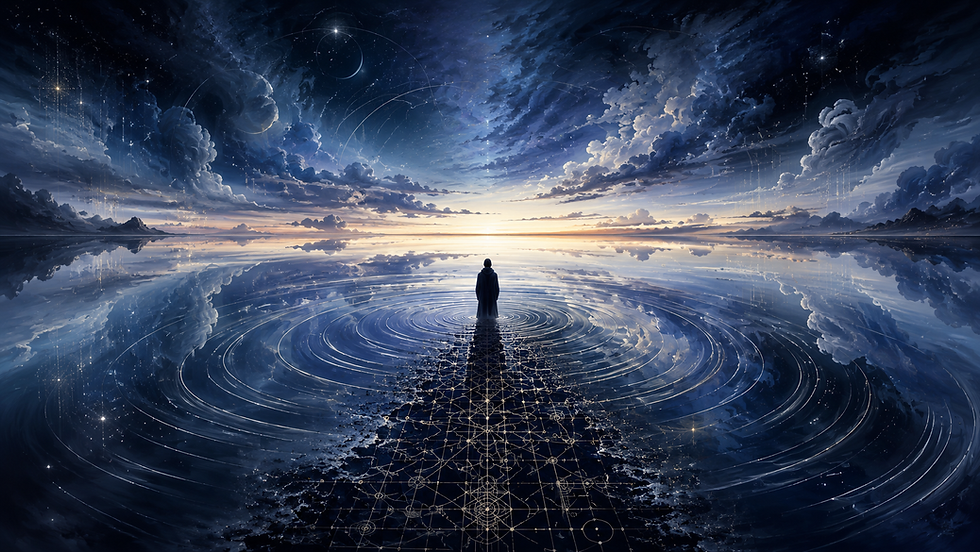
What makes a river a river is its banks. They are what hold the water to a course — what give it an edge, a direction, a name. Without them there is no river. Only water, going everywhere or nowhere, indistinguishable from the land.
The whole search, from the first page, was a search for the banks. For the feature of the world that would catch the current and hold it — that would let us say there, that is the thing that moves, and this is how fast, and that is where it goes. We went looking. We did not find them. Physics handed back a still landscape and no edges. The mind handed back a performance and no proof. The river we are so certain of turns out to run between no banks at all.
And still it carries us. That is the part no argument touches. We feel the pull, the downhill, the not-yet becoming the no-longer; we feel ourselves moving even as the ground beneath the motion refuses to appear. Two things, both true, that will not be folded into one: a universe that does not flow, and a life that cannot stop flowing.
Perhaps the banks were never the point. Perhaps we mistook where the river lives — searched the indifferent landscape for it when all along it was in the swimming. The current is not a fact the cosmos keeps. It is the shape of what it is to be briefly awake inside of time. Lit for a stretch. Feeling ourselves go.
So there is no need to find the banks. There never were any to find.
There is only the water — and the strange grace of being something that can feel itself carried, for now, in the only now there is.
Where, after all, were we ever rushing to?


Comments