


Borrowed Light: Is There Such a Thing as an Original Idea
The Illusion of Originality
There is a particular kind of quiet pride that accompanies a new thought. The sudden sense of arrival — I’ve got it — as though the mind had just invented something the universe had been waiting for. It feels clean. Sovereign. Entirely one’s own.
But sit with that feeling long enough, and it begins to shift.
Where did the words come from — the very ones used to frame the thought? Inherited. Where did the categories of meaning come from, the mental scaffolding that made the idea recognizable as an idea at all? Absorbed, over years, from teachers, books, conversations half-remembered, arguments overheard in childhood. The thought felt original. But it arrived dressed in borrowed clothes.
This isn’t a counsel of despair. It is, perhaps, an invitation to look more honestly at what thinking actually is.
Consider how rarely a genuinely new concept appears — not a recombination, not a reframing, not an old intuition wearing contemporary vocabulary. The history of ideas, when examined closely, looks less like a series of inventions and more like a long, patient conversation — each voice responding to the ones before it, often without knowing it. Philosophers echo each other across centuries without having read each other. Mystics in traditions separated by oceans arrive at strikingly similar metaphors. Scientists working in isolation converge on the same discovery at the same moment, as though the idea itself had ripened and was simply waiting to be picked.
What does that suggest? That ideas may not belong to minds so much as pass through them.
And yet — something resists this conclusion. There is a felt difference between genuine insight and mere repetition. Between the mind that only recirculates and the one that somehow, against all odds, turns the familiar into the luminous. Maybe originality isn’t about creating from nothing. Maybe it never was. Maybe it is something quieter and stranger — a particular quality of attention, a willingness to hold borrowed light at just the right angle until it reveals something that wasn’t visible before.
Borrowed Light: How Every Mind Stands on Other Minds
Newton called it standing on the shoulders of giants. It was a gracious acknowledgment — and, some historians note, possibly a barbed one, aimed at a rival he despised. Even that famous gesture of intellectual humility, it turns out, was borrowed. The image predates Newton by centuries.
Which is, in its own quiet way, the point.
No mind arrives empty into the world. Language is waiting. Culture is waiting. An entire architecture of inherited assumption stands ready to receive the newborn’s first confused impressions and slowly, imperceptibly, shape them into something called a self. By the time that self forms its first conscious opinion — about beauty, justice, God, the nature of time — it has already been furnished, floor to ceiling, by forces it did not choose and may never fully inventory.
This is not a comfortable thought for those of us who prize independent thinking. And yet it may be a liberating one, if held correctly.
Consider what it means to read a book that changes everything. Something in the writing reaches across time and touches something in the reader that was already there, dormant, waiting for precisely that formulation. Was the idea the author’s? Was it the reader’s? Or was the book merely the occasion — the particular angle of light that finally made the hidden contour visible? There is a reason certain texts feel less like information received and more like memory recovered. As though the mind were not learning something new but recognising something old.
Wordsworth felt this. So did Plato — his entire theory of knowledge rested on the premise that learning is remembering, that the soul arrives already acquainted with truth and spends a lifetime struggling back toward what it once knew. One need not accept the metaphysics to feel the phenomenological accuracy of the description.
And then there is the subtler inheritance — the emotional one. The fears absorbed from a parent’s unspoken anxiety. The aesthetic preferences shaped by a piece of music heard at an impressionable age. The philosophical leanings quietly installed by a single teacher who may not even be remembered by name. These are not ideas exactly. But they are the soil in which ideas grow. And soil, as any gardener knows, determines almost everything.
What we call our worldview — our most intimate, most fiercely held perspective on existence — is, in large part, a palimpsest. Layer upon layer of other voices, other lives, other struggles with the same irreducible questions. To think is to enter a conversation that was already in progress. The best one can hope for, perhaps, is to listen carefully enough — and then, occasionally, to add a line that makes the whole thing ring slightly differently than it did before.
That, too, would be enough.
The Gap-Filler: When Reason Runs Out
Science is one of the most breathtaking achievements of the human mind. Its method — observation, hypothesis, testing, revision — has dismantled superstition, extended life, mapped the cosmos down to the curvature of spacetime and up to the behaviour of quarks. There is no honest way to diminish that.
And yet.
At the edges of every map, there is still the old cartographer’s confession: here be dragons. Not because science has failed, but because the questions that remain are of a peculiar and stubborn kind — the ones that don’t yield to measurement, that retreat further the more precisely they are pursued.
What is consciousness? Not the neural correlates of it, not the electrochemical choreography that accompanies it — but the fact of it. The sheer inexplicable thereness of inner experience. The hard problem, as philosopher David Chalmers named it, remains exactly that. Hard. Neuroscience can tell us which regions of the brain light up during a moment of awe or grief or recognition. It cannot tell us why there is something it feels like to be a person standing in the rain.
Or consider the cosmological origin question — not the mechanics of the Big Bang, which physics handles with remarkable precision, but the prior question: why is there something rather than nothing? Why does the universe exist at all, and why does it exist with these constants, calibrated so finely that the slightest variation would have produced a cosmos without stars, without chemistry, without the conditions for anything to wonder about anything?
These are not gaps born of ignorance. They are structural. They arise not from a lack of data but from the nature of the questions themselves — questions that seem to exceed the jurisdiction of the empirical method entirely.
And here, reliably, across every culture and every century, something else moves in.
Call it God. Call it the ground of being, the Tao, Brahman, the ineffable. The names differ wildly; the function is strangely consistent. It is the answer that arrives when the answering runs out — not as a logical conclusion but as a felt necessity. A placeholder, the sceptic says. A revelation, the believer insists. Perhaps it is neither, or both, or something for which the language simply hasn’t arrived yet.
What is worth noticing is the shape of the gap — because it is not random. It always appears at the same threshold: the point where causality loops back on itself and asks who started it, where matter becomes aware of itself and asks how, where meaning is sought in a universe that offers no instruction manual. The gap, in other words, appears precisely where the human need for coherence is most acute and most unanswerable.
Whether God fills that gap or merely inhabits our need for one — that is a question each mind must sit with alone, in honesty, without the comfort of either easy faith or easy dismissal.
What cannot be honestly denied is this: something in human consciousness refuses to stop at the edge. It leans out. It asks the unanswerable question one more time. And in that restless, reaching posture — neither certain nor resigned — there may be something more truthful than any answer yet proposed.
In the Beginning Was the Word
Before the idea, there was the sound.
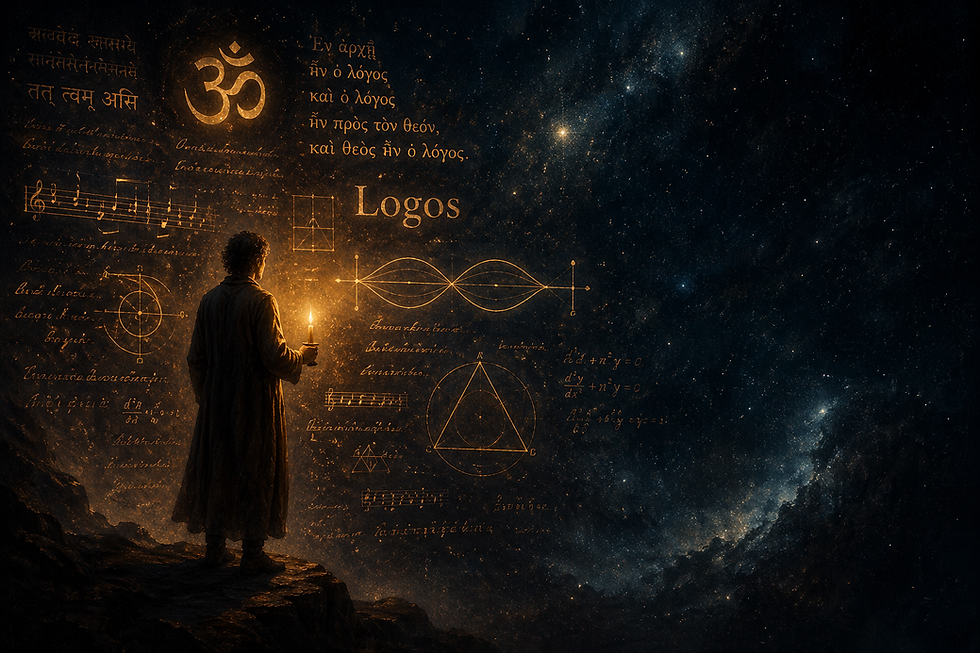
Every major tradition, arriving independently, across geography and millennium, seems to have intuited something similar: that creation did not begin with matter, or light, or even thought — but with vibration. With a sound that preceded all other sounds. A first word spoken into silence that was not empty but somehow pregnant, waiting.
In the Hindu tradition, that sound is Om — or more precisely, Aum. Not merely a syllable to be chanted but a cosmological fact, a sonic representation of the totality of existence: the waking, the dreaming, the deep sleep, and the silence that holds all three. The Mandukya Upanishad treats it not as a symbol pointing toward reality but as reality itself compressed into vibration. To sound it with full attention is, the tradition claims, to briefly touch the source.
Christianity opens its most philosophically dense gospel — John’s — with a declaration that still resonates strangely across centuries: In the beginning was the Word. The Greek Logos carries more freight than the English translation suggests — it implies not just speech but reason, order, the structuring principle underlying all things. The Word was not merely spoken by God; it was God. Creation as utterance. Existence as ongoing speech.
Islam holds the Quran not as a book about God but as the literal, uncreated word of God — Kalam Allah. And its own resonant affirmation, Amin — cognate with the Hebrew Amen, with which Jewish prayer has long sealed its intentions — carries the weight of confirmation, of cosmic ratification. So be it. Let it be so. As though reality itself required agreement, a spoken yes, to solidify into being.
These are not the same tradition. The theologies diverge, sometimes dramatically, on almost everything else. And yet here, at the question of origin, they converge on the same impossible image: sound before substance. The word before the world.
What to make of this, standing outside any single tradition?
One possibility is the cynical one — that all these traditions were working with the same limited human intuition, the same cognitive bias toward narrative and language, and independently arrived at the same poetic metaphor without it pointing to anything beyond human psychology. That the first word is a story we tell ourselves because we are, above all else, storytelling creatures.
Another possibility is stranger and harder to dismiss entirely. That these traditions were not inventing but tracking something — that the convergence is not coincidence but signal. Modern physics, after all, describes a universe that is at its deepest level not made of things but of vibrations — quantum fields oscillating, particles that are not particles at all but excitations in an underlying medium. The language is different. The image is not entirely unlike.
String theory, for all its mathematical beauty and physical unverifiability, posits that the fundamental constituents of reality are one-dimensional vibrating strings — and that different modes of vibration give rise to different particles, different forces, different expressions of what we call matter. Whether or not the theory is ultimately correct, it is worth pausing over the metaphor it reaches for: the universe as instrument. Existence as resonance.
Perhaps the mystics and the physicists are not saying the same thing. Almost certainly, they are not. But they are, perhaps, standing at the same edge — looking into the same darkness — and independently noting that whatever lies there hums.
The first word, then, may not be a word at all in any linguistic sense. It may be the name we give to that hum — the irreducible vibration at the base of everything — because the alternative is silence, and silence, for a mind that must understand, is simply unbearable.
Or perhaps silence is the first word. And everything else — every idea, every tradition, every borrowed light passed from mind to mind across the centuries — is simply the echo.
The Midnight Idea: Gifts From the Unconscious
It arrives without announcement.
Not during the hours of deliberate effort — not at the desk, not mid-argument, not in the middle of carefully constructed thought. It comes in the shower. At the threshold of sleep. On a walk where the mind has been given, briefly, nothing in particular to do. A solution to a problem that had resisted weeks of conscious assault. A line of writing that feels more found than composed. An understanding of another person that arrives whole, without any visible chain of reasoning leading to it.
The experience is nearly universal. And it raises a question that is genuinely uncomfortable for those who hold the rational mind in high regard: if the insight arrived without conscious effort, whose insight was it?
Henri Poincaré, one of the great mathematicians of the nineteenth century, described the moment a key mathematical discovery arrived fully formed while stepping onto a bus — his conscious mind occupied entirely with something else. He had not been thinking about the problem. And yet some process had continued, invisible, patient, working in a register he had no direct access to. The answer simply surfaced, the way a deep-sea creature occasionally rises into the light — not because it was summoned, but because the conditions were finally right.
Kekulé dreamed of a snake eating its own tail and woke to the structure of benzene. Paul McCartney heard Yesterday in a dream, convinced for weeks that he must have unconsciously plagiarised it from somewhere, because nothing that complete could have simply arrived. Einstein credited his insights less to logical deduction than to what he called combinatory play — a kind of relaxed, associative mental wandering that the disciplined intellect too easily forgets to allow.
What is happening in these moments?
Psychology offers a partial answer. The unconscious mind — or more precisely, the non-conscious processing systems that operate beneath the threshold of awareness — continues to work on problems long after the conscious mind has moved on. It has access to more material than the conscious mind can hold at once: every experience, every half-absorbed reading, every pattern noticed and filed without comment. When a connection is made, it surfaces. The conscious mind, mistaking itself for the whole operation, calls it inspiration.
The mystic traditions frame it differently. In the Vedantic understanding, the individual mind is not a self-contained generator of thought but more like a receiver — a particular aperture through which universal consciousness expresses itself. What we experience as sudden insight may be less a product of the individual mind and more a moment of genuine reception, when the static clears and something larger than the personal briefly comes through.
Both framings have their appeal. Neither is entirely satisfying.
Because here is what remains strange: not all unconscious processing produces insight. The same depths that occasionally deliver something luminous also circulate fear, prejudice, unexamined assumption, and every variety of self-deception. The unconscious is not a benign oracle. It is a vast, largely unmapped interior — capable of wisdom and capable of profound distortion in equal measure. Trusting it uncritically is its own kind of naivety.
And then there is the question that neither psychology nor mysticism fully resolves: can a sudden idea, arriving without apparent conscious precedent, be considered an original idea? Even granting that something remarkable has occurred — that the conscious mind genuinely had no awareness of the process that produced it — the raw material still came from somewhere. The experiences absorbed. The patterns noticed. The questions held, perhaps for years, in a kind of interior suspension. The midnight idea is not created from nothing. It is distilled from everything.
Which returns us, quietly, to where this exploration began.
Perhaps the most honest thing that can be said about an original idea is that it is a gift — but a gift whose ingredients were always already present, waiting in the dark for the right configuration, the right moment of stillness, the right quality of receptive attention. The mind does not invent so much as it prepares — and then, occasionally, has the grace to step aside.
What arrives in that stepping aside may not be original in any absolute sense. But it may be the closest the human mind ever comes to touching something that feels, however briefly, like it does not entirely belong to it.
And that, perhaps, is wonder enough.
Standing at the Edge of the Unknowable
Every inquiry, pursued honestly far enough, arrives here.
Not at an answer. At an edge. A place where the ground of certainty gives way to something less solid — not quite void, not quite substance — and the mind, so accustomed to forward motion, finds itself simply standing. Looking out. Uncertain whether what lies ahead is darkness or depth.
This is not failure. It may, in fact, be the most important place thinking can reach.
The question that has threaded itself through everything explored here — whether anything is truly original, whether thought belongs to the thinker, whether the first sound still reverberates in every idea that follows, whether the midnight insight is gift or distillation or both — does not resolve. It deepens. Each partial answer opens into a larger question, the way a door opened in a dream reveals not a room but another corridor, stretching further than expected into the dark.
And perhaps that is precisely the point.
What does it mean that human consciousness is structured this way — perpetually reaching beyond what it can verify, perpetually unsatisfied with the provisional, perpetually haunted by the sense that the most important things lie just past the boundary of the knowable? Other animals, as far as can be determined, do not lie awake wondering about the nature of their own awareness. They do not build cosmologies or argue about the first word or feel the particular vertigo of tracing an idea back through its influences and finding the trail does not end.
Only this strange creature does that. Only this mind, assembled from borrowed light, turns the light back on itself and asks: but where did it come from?
There is something almost comedic about it. And something quietly magnificent.
The traditions that speak of Aum, of Logos, of the uncreated Word — they are not, at their most honest depths, claiming to have answered the question. They are claiming to have found a way to inhabit it. To stand at the edge without flinching. To let the unknowable be unknowable without filling it prematurely with either dogma or dismissal. The sound of Aum, held in contemplation, does not explain creation — it creates a space in which the mystery of creation can be felt without being collapsed into something smaller than it is.
That is no small thing.
Science, at its own honest edge, does something similar. The physicist who sits with the fine-tuning problem — who acknowledges that the constants of the universe are calibrated with a precision that staggers the imagination and that no current framework fully explains — is not, in that moment of acknowledgment, being unscientific. They are being rigorous in the deepest sense: refusing to pretend the map is complete when it clearly is not.
The danger, always, is on both sides. The believer who rushes to fill the gap with certainty — who mistakes the felt need for God with proof of God, who converts the mystery into doctrine before the mystery has been properly honoured — loses something essential in the conversion. But so does the sceptic who mistakes the absence of proof for proof of absence, who turns rigorous doubt into its own kind of closed system, who has never allowed themselves to be genuinely unsettled by the strangeness of existence.
To stand at the edge honestly requires holding both impulses without letting either win entirely.
What, then, is an original idea? Perhaps it is this: the moment a borrowed mind, assembled from the fragments of everything that came before it, turns toward the unknowable with fresh attention — not because it expects to solve it, but because it cannot help itself. Because the question is irresistible. Because something in consciousness, deeper than culture and older than language, leans perpetually toward what it cannot name.
Every tradition’s first word — Aum, Logos, Amin — is an attempt to name that leaning. Every scientific theory pushed to its limit is another attempt. Every midnight idea that arrives unbidden, every insight passed like a torch from one mind to another across centuries, every act of genuine attention paid to a question that will not close — these are all, in their different registers, the same gesture.
A reaching. Into borrowed light. Toward something that may not be knowable but that, somehow, insists on being sought.
That insistence — unreasonable, unkillable, quietly magnificent — may be the only truly original thing about us.


Comments